


How South African universities assess master’s dissertations and doctoral theses is no longer a narrow technical matter. It is increasingly bound up with wider questions of academic fairness, transparency, epistemic inclusion, scholarly independence and the future shape of postgraduate education itself.
These questions came into sharp focus during World Café 3, titled The Assessment Process for Postgraduate Qualifications, at the third Enabling Quality Postgraduate Education (EQPE) colloquium that was hosted on the East Rand in Gauteng from 16 to 17 March 2026.
In conferencing practice, a World Café is a structured discussion format designed to generate collective insight through focused, table-based conversation. Participants engage around a defined theme, test ideas in smaller groups, and build on one another’s contributions, often surfacing both common concerns and productive disagreements. In this session, the format was especially suited to a subject as layered and consequential as postgraduate assessment, where institutional practice, disciplinary culture and national policy intersect.
The discussion opened with provocations from a panel of academic leaders, each highlighting different tensions within the assessment process.
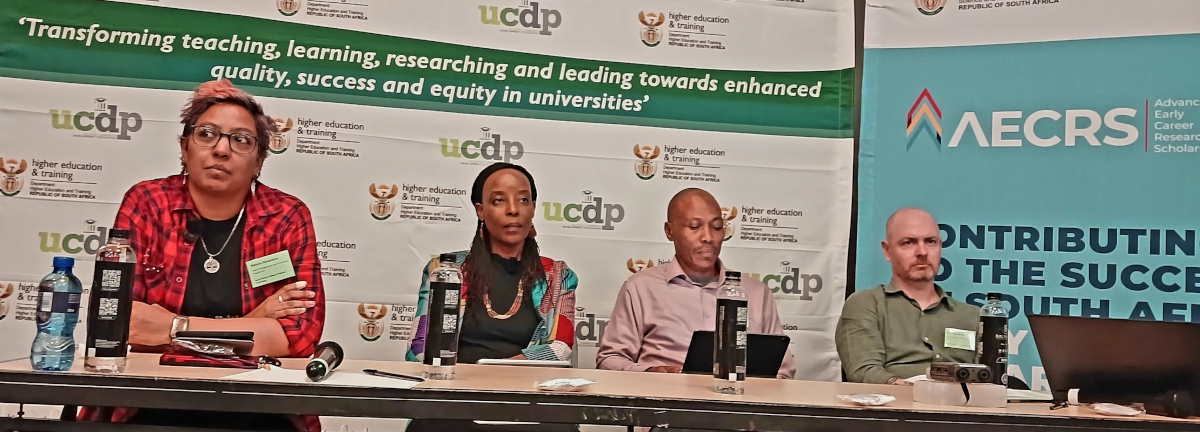
From left, Ms Natalie Donaldson from the South African College of Applied Psychology (SACAP); Professor Sibusiso Moyo, DVC: Research, Innovation and Postgraduate Studies at Stellenbosch University; Professor Karabo Shale, Director: Postgraduate Studies at the University of the Free State; and Professor Izak van Zyl, Director: Centre for Postgraduate Studies at Cape Peninsula University of Technology.
Mx Natalie Donaldson, Head of Postgraduate and Professional Programmes at the South African College of Applied Psychology (SACAP), set the tone by challenging the assumption that dissertation examination is a settled and unproblematic guarantor of academic quality. She observed that the examination of a master’s dissertation or doctoral thesis is often treated as a “sacred mechanism” for measuring standards in postgraduate education. And the entire process is often undertaken under a cloak of secrecy that warrants much closer scrutiny.
Donaldson argued that one of the most persistent tensions lies between consistency and subjectivity. In principle, she explained, the use of two or three independent examiners should strengthen quality assurance by allowing a thesis to be tested from multiple scholarly vantage points. In practice, however, the same work can produce markedly different evaluations.
“One report may describe the thesis as innovative, well-argued and making a meaningful contribution,” Donaldson noted, “while another may question its theoretical depth or methodological approach.”
These differences, she made clear, do not automatically indicate failure in the system. But they do raise a more difficult question: to what extent are assessment standards genuinely shared across disciplines and institutions, and to what extent are they shaped by the preferences, assumptions and intellectual commitments of individual examiners?
Donaldson also drew attention to what she termed the “invisible curriculum” of postgraduate research. While universities may publish formal guidelines for dissertation writing and examination, many of the expectations that ultimately shape assessment outcomes are only communicated informally through supervision, disciplinary culture and institutional habit. This can disadvantage some students.
“For first-generation scholars or students from historically disadvantaged institutions, the expectations embedded within the examination process may be less transparent,” she explained. “In this way, the examination system may unintentionally reproduce existing inequalities in access to academic capital.”
Her intervention broadened further into questions of transformation and epistemic diversity. South African higher education, she pointed out, has committed itself to serious engagement with decolonisation, locally grounded scholarship and diverse knowledge systems. Yet the frameworks through which dissertations are often assessed remain closely aligned to older academic traditions that privilege particular writing conventions, theoretical lineages and methodological norms.
“This raises a provocative question,” Donaldson said. “Can an examination system shaped largely within historical Eurocentric academic traditions really recognise and value alternative ways of producing knowledge?”
Do our assessment models differentiate between doctoral pathways?

Professor Sibusiso Moyo (left), Deputy Vice-Chancellor for Research, Innovation and Postgraduate Studies at Stellenbosch University, extended the conversation by asking what it means to examine a doctorate in the present moment. Her contribution shifted the discussion from the thesis as an object to the doctoral candidate as an emerging scholar.
“What exactly are we examining when we examine a doctorate?” Professor Moyo asked, pressing delegates to think beyond inherited habits.
She argued that this question becomes more pressing when one considers the diversification of doctoral pathways. A traditional Doctor of Philosophy may prepare a candidate for academic life in the university. At the same time, a professional doctorate may be more explicitly oriented towards industry, practice or applied problem-solving. If the intended outcomes differ, she suggested, the assessment process should at least consider whether a single model remains adequate.
“Should a PhD for somebody who is going to become a scholar in the university be examined in the same way as that of somebody pursuing a professional doctorate?” she asked.
Fairness must be the central concern of assessments
Professor Moyo acknowledged that the written thesis remains an important measure of knowledge production but argued that it cannot capture everything. A viva voce examination, for instance, may offer examiners a clearer sense of intellectual independence, ethical reasoning, reflexivity and the candidate’s ability to defend methodological choices. Yet she also warned that oral formats are not free of difficulty.
“In a community as diverse as ours,” she cautioned, “people may end up judging language and how you speak rather than the scientific content.”
That concern, she implied, is not marginal. It goes to the heart of fairness. An assessment system that privileges fluency, performance style or dominant linguistic norms may disadvantage students who know their work deeply but do not present in ways traditionally rewarded by the academy. The concern becomes even more acute when disability is considered, or when scholarship is rooted in indigenous knowledge systems that may not be legible to external examiners unfamiliar with local contexts.
“What do you do with indigenous knowledge systems,” Professor Moyo asked, “if the people outside your boundaries might not know the field very well?”
She also raised the increasingly difficult issue of interdisciplinary and transdisciplinary research. As boundaries between fields become more porous, identifying appropriate examiners becomes more complex. A thesis that draws from multiple disciplines may be misread if assessed only through a narrow disciplinary lens, and candidates may be penalised — not because the work lacks merit, but because the system is not yet well configured to evaluate scholarship that crosses conventional categories.
Impartiality in doctoral examiners
Professor Karabo Shale (right), Director of Postgraduate Studies at the University of the Free State, approached the matter through the lens of fairness, consistency and examiner preparation. He questioned whether postgraduate assessment across South Africa is sufficiently standardised to protect candidates from uneven judgment.
“Are we really being fair and consistent when we assess postgraduate work?” He asked.
His concern was not abstract. He pointed to the familiar problem of significantly divergent examiner reports on work of comparable quality, arguing that the variation is too often accepted as normal when it may, in fact, point to inconsistent standards, insufficient calibration, or bias.
“You still have two or three examiners having different marks, 51, 71, on the same thesis,” he argued. “So the question is: are we really being fair? Are we not being biased?”

Professor Shale called for a more deliberate national conversation about assessment criteria, examiner development and alignment with institutional learning outcomes. In his view, examiner expertise should not be assumed merely because someone holds a doctoral degree or academic seniority. Ongoing professional development, validation processes and systematic feedback are necessary if postgraduate assessment is to command confidence across the sector.
Professor Izak van Zyl (left), Director of the Centre for Postgraduate Studies at Cape Peninsula University of Technology, added another dimension to the discussion by questioning the continued dominance of the thesis as the central and often near-exclusive object of postgraduate assessment.
“The dominant way in which we assess postgraduate research, particularly at doctoral level, has not really changed for over a century,” Professor van Zyl argued.
Evaluating the thesis vs the researcher?
His provocation was pointed. Universities frequently state that postgraduate education is intended to produce ethical, independent researchers able to contribute to knowledge and society. Yet when assessment takes place, the process usually focuses on a single document rather than the broader development of the researcher.
“If our goal is to develop researchers,” he asked, “why do we mostly assess the thesis rather than the researcher?”
This distinction matters, he suggested, because the thesis can obscure as much as it reveals. A polished document does not necessarily show how intellectually independent the candidate became, how much conceptual labour was carried by supervisors, how ethically the research process unfolded, or, in the age of generative artificial intelligence, what or who actually produced portions of the final text.
“The thesis can obscure quite a lot,” Professor van Zyl observed. “It can obscure how independent the candidate really became, how much intellectual work was done by supervisors, how ethical the research process was, and, in the era of generative AI, who or what actually produced parts of the text.”
His remarks sharpened the central tension running through the session: whether current postgraduate assessment practices remain fit for the conditions under which knowledge is now produced.
What emerged from World Café 3 was not a simple rejection of existing systems. Rather, it was a serious interrogation of their adequacy. The session brought together questions of examiner consistency, student access to tacit academic norms, the status of oral examinations, the assessment of interdisciplinary and indigenous knowledge, the effects of technological change, and the need to align examinations more closely with what universities claim postgraduate education is meant to achieve.
The 2026 colloquium was the last in a three-part series led by the Enabling Quality Postgraduate Education (EQPE) project, led by Professor Sioux McKenna, Director: Postgraduate Studies at Rhodes University, and funded by the Department of Higher Education and Training (DHET). The initiative was implemented in partnership with the Community of Practice for Postgraduate Education and Scholarship (CoP PGES), a group of Universities South Africa (USAf), chaired by Professor Stephanie Burton from the University of Pretoria, and operating under the Advancing Early Career Researchers and Scholars (AECRS) programme.
Bhekisisa Mncube is a contract writer for Universities South Africa.