



South African universities must urgently clarify the distinction between master’s and doctoral qualifications if the sector is to safeguard academic standards and strengthen its contribution to national development.
The central message emerged from World Café 1, titled Differentiation in Postgraduate Studies, a structured approach in which participants build shared insight through small-group dialogue. The session formed part of the third Enabling Quality Postgraduate Education (EQPE) colloquium hosted on the East Rand in Gauteng, from 16-17 March 2026.
This colloquium was the third in a series led by the EQPE project and funded by the Department of Higher Education and Training (DHET). It was implemented in partnership with the Community of Practice for Postgraduate Education and Scholarship (CoP PGES), a group of Universities South Africa (USAf) operating under the Advancing Early Career Researchers and Scholars (AECRS) programme.
The session gathered senior academics, supervisors and higher education leaders to interrogate the differentiation between postgraduate qualifications and their alignment with research, industry and societal needs.
Professor Stephanie Burton, Chair of the CoP PGES at USAf and a Professor at the University of Pretoria’s Future Africa campus, framed her input around the fundamental principles.
Master’s vs doctoral degree

“A master’s degree is about advanced knowledge acquisition, while a doctorate is about creating new knowledge,” Professor Burton (left) explained. She said the distinction is not merely technical, but intellectual, requiring different levels of independence, originality and methodological sophistication.
Professor Burton stressed that doctoral education is designed to produce scholars capable of making original contributions to knowledge, while also developing advanced research competence.
“A doctoral programme is fundamentally about making an original contribution and demonstrating research proficiency at the highest level,” she said.
She added that such training builds analytical depth, strengthens intellectual independence and prepares graduates for leadership roles in academia, policy and research environments.
A professional doctorate
Turning to professional doctorates, Professor Burton noted that these qualifications are designed to address real-world problems and to bridge the gap between theory and practice.
“They link theory to practice and are often located in fields such as education, health care and management, but they still require a strong research component,” she said.
She emphasised that professional doctorates are not lesser qualifications but differently oriented programmes with distinct purposes and outcomes.
Professor Burton raised concerns about the misalignment between postgraduate education and the realities of employment, noting that many graduates do not enter academic careers. “We speak about workplace readiness at all levels, but we do not always define what that workplace is,” she said.
She argued that this requires a reconsideration of programme design, particularly the role of coursework in preparing students for research, interdisciplinary engagement and broader societal impact.
“In South Africa, we do not have coursework in most Doctor of Philosophy programmes, and that raises questions about readiness for research,” she said. “And where we do have it, the Higher Education Qualifications Sub-Framework (HEQSF) indicates that it cannot be for credit.”
Professor Burton called for postgraduate programmes to reflect national and continental priorities, including innovation, relevance and societal benefit.
“If we are serious about impact, we must ask what skills we are developing and how they align with the future we are trying to build,” she said.
Earnest introspection needed in the SA system
Professor Anil Chuturgoon (right), Deputy Vice-Chancellor for Research and Innovation at the University of KwaZulu-Natal (UKZN), offered a more critical assessment of the current system.
“Are we clear on what separates a master’s from a doctorate, or are we in pretend mode while our degrees lose significance?” Professor Chuturgoon asked.
He said the distinction between qualifications has become blurred, with consequences for both academic standards and national innovation.
“A master’s is often reduced to a polished collection of coursework, while a doctorate is expected to reshape knowledge, but this distinction is not consistently upheld,” he said.
Professor Chuturgoon argued that the lack of clarity is evident across institutions, where both students and staff struggle to articulate meaningful differences between qualification levels.
“If you ask across campuses what the difference is, you will receive vague answers, often limited to qualification frameworks rather than intellectual substance,” he said.

He attributed this to systemic pressures, including funding constraints, administrative burdens and institutional incentives linked to enrolment and throughput.
“Supervisors are stretched, managing multiple postgraduate projects, and this inevitably affects the depth and quality of supervision,” he said
Professor Chuturgoon said many students pursue master’s degrees primarily for credential purposes, rather than for intellectual or research development.
“Students choose a master’s because a doctorate appears to be prolonged suffering, but that choice has implications for the system,” he said.
He warned that the consequences extend beyond universities, affecting the country’s research capacity and innovation trajectory.
“We are producing graduates who cannot innovate, while those who are capable often leave the country,” he said.
“The brain drain will accelerate if we do not address this structural problem,” he added.
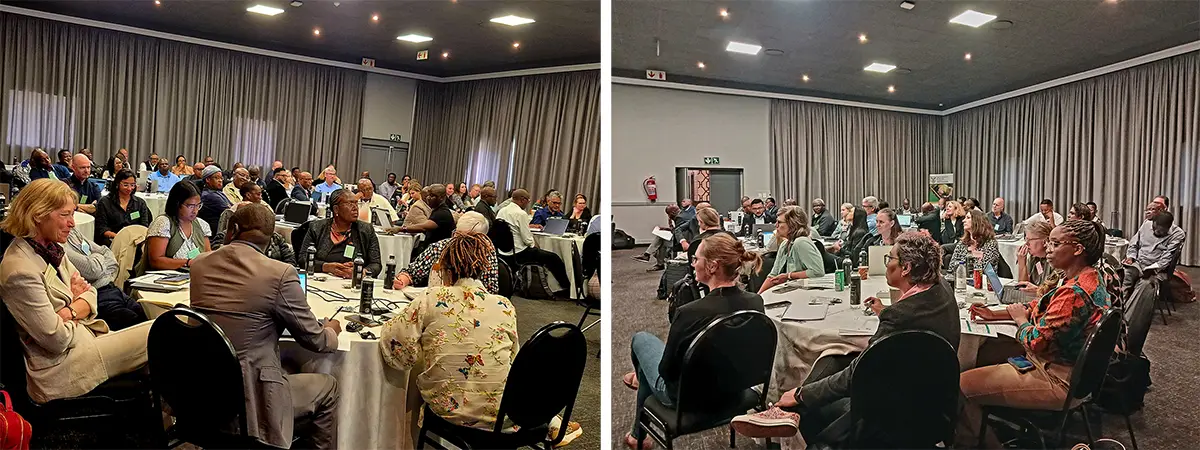
The EQPE colloquium was well attended, gathering a total of 120 participants representing senior academics, research supervisors and higher education leaders.
The solution lies in programme design
Professor Chuturgoon called for greater transparency in programme design, with clear articulation of the purpose and expectations of each qualification.
“Every programme handbook must state explicitly what a master’s does and what a doctorate does, without ambiguity,” he said.
He also called for a reconfiguration of supervision models, suggesting that master’s programmes should focus on applied or limited research, while doctoral programmes should be reserved for original scholarship.
“Original knowledge creation must remain the defining feature of a doctorate, otherwise we dilute its value,” he said.
He further emphasised the importance of industry partnerships in evaluating postgraduate outcomes.
“Employers must assess outputs, not just qualifications, and that requires stronger alignment between universities and industry,” he said.

Professor H. B. Klopper (left), Academic Head at Belgium Campus iTversity, approached the issue through the lens of differentiation and institutional readiness, placing what he described as the “elephant in the room” at the centre of the discussion.
“Differentiation does not mean dilution; it means recognising multiple pathways to rigorous and impactful knowledge creation,” Professor Klopper said.
He argued that professional postgraduate qualifications are not deviations from academic standards, but rather deliberate responses to complex, real-world challenges that require applied research, interdisciplinary thinking, and closer engagement with industry.
“The purpose of professional postgraduate qualifications is impact in practice, and that must shape how we design and assess them,” he said.
Professor Klopper described the current evaluation system as a legacy model that continues to privilege traditional academic outputs, even when the intended outcomes of programmes differ fundamentally.
“We remain anchored in a system that asks how many theses were written or how many articles were published, instead of asking what changed in practice,” he said.
He maintained that the provocation for institutions is to redefine what constitutes meaningful knowledge production within applied contexts.
“We must ask not only what was written, but what knowledge was generated and what changed in practice as a result,” he said.
Applied research is equally relevant and deserves respect
Professor Klopper emphasised that applied research, particularly when undertaken in collaboration with industry, demands the same level of methodological rigour as conventional academic research.
“On the surface, it may resemble an industry project, but beneath that lies rigorous methodology, careful design and significant intellectual work,” he said.
He added that such research often engages directly with pressing societal and economic challenges, positioning it as a critical driver of innovation and development.
Professor Klopper raised concerns about supervision practices, noting that many academic supervisors continue to replicate inherited models that may not be well-suited to practice-based research.
“Most supervisors supervise in the way they were trained, and that may not be sufficient for practice-based research,” he said.
He argued that this creates a structural limitation in postgraduate education, particularly for programmes that seek to integrate theory with real-world application.
“Supervision must bring together academic and practical expertise if we are serious about bridging theory and practice,” he said.
Professor Klopper called for the deliberate inclusion of practitioners and industry experts in supervision teams, describing this as essential for strengthening the credibility and relevance of professional postgraduate qualifications.
Institutional reform is needed for the success of differentiated pathways
He further questioned whether institutions are adequately prepared to supportdifferentiated postgraduate pathways, particularly those centred on applied research and innovation.
“Are our institutions ready to support professional postgraduate research as a major driver of innovation and national development?” he asked.
He cautioned that without structural reform, institutions risk constraining the potential of professional postgraduate programmes.
“We cannot measure all postgraduate work against the same standard if the purposes are fundamentally different,” he said.
Professor Klopper concluded that the challenge facing universities is not whether to differentiate, but whether they are willing to align evaluation, supervision and institutional systems with the diverse purposes of postgraduate education.
Bhekisisa Mncube is a contract writer for Universities South Africa