


South Africa’s postgraduate education system is producing more graduates than ever before. Yet universities are increasingly confronting a harsher truth: too many students arrive unprepared, too many supervisors are insufficiently supported, and too many policies reward numbers over knowledge.
It was this uneasy contradiction that framed the opening of the third Enabling Quality Postgraduate Education (EQPE) colloquium, where a stark question lingered, not whether the system is expanding, but whether it is holding.

“Many things keep me awake at night,” reflected Dr Kwezi Mzilakazi (left), Deputy Vice-Chancellor for Research, Innovation and Strategic Partnerships at Rhodes University, opening a searching conversation on the future of postgraduate education in South Africa.
Her reflection anchored the thematic thrust of the third Enabling Quality Postgraduate Education (EQPE) colloquium, titled ‘Enhancing the Knowledge Project’. Academics, research leaders and postgraduate specialists interrogated the structural, institutional and epistemic pressures shaping postgraduate training across the sector, situating assessment within a broader contestation over knowledge production, fairness and transformation.
The 2026 colloquium forms part of the EQPE project headed by Professor Sioux McKenna of Rhodes University and funded by the Department of Higher Education and Training (DHET). The initiative is implemented in partnership with the Community of Practice for Postgraduate Education and Scholarship (CoP PGES), under Universities South Africa (USAf)’s Advancing Early Career Researchers and Scholars (AECRS) programme.
Framing her remarks through the lived realities of a rural-based institution, Dr Mzilakazi emphasised that postgraduate education cannot be reduced to mere curriculum delivery. She argued that institutional context, campus life and research support systems are inseparable from academic success.
“What keeps me awake,” she insisted, “is the provisioning of quality postgraduate education and the experience of the postgraduate cohort.”
She explained that for universities such as Rhodes University, which operate outside major metropolitan centres, “what happens on campus is just as important as the quality of the master’s or doctoral programme itself”.
Her input set the tone for a colloquium marked by candour, with participants repeatedly returning to four interlinked pressures: student preparedness, supervision capacity, funding constraints and policy misalignment.
Postgraduate selection
Dr Sharol Mkhomazi, Assistant Dean for Research at Tshwane University of Technology (TUT), challenged prevailing assumptions about postgraduate selection, questioning whether academic performance alone can reliably predict doctoral potential.
“Is ‘cream of the crop’ a real measurement?” she asked, warning that institutions are admitting candidates who meet formal thresholds yet struggle with the intellectual demands of postgraduate study.
She cautioned that the problem extends beyond selection to the broader academic pipeline. “Preparedness does not start at master’s level,” she emphasised, noting that foundational gaps in research training are often evident long before students enter postgraduate programmes.
Professor Lutendo Murulana (right), Deputy Dean for Research and Postgraduate Studies at the University of Venda (UNIVEN), who highlighted structural weaknesses in curriculum design, echoed Dr Mkhomazi’s concern.
Student preparedness and supervisory capacity
“A student can complete an undergraduate qualification without any exposure to research,” Professor Murulana explained. “That gap follows them into postgraduate studies.”
If preparedness emerged as one axis of concern, supervision capacity proved equally urgent. Professor Sechene Stanley Gololo, an Associate Professor and Deputy Dean in the School of Science and Technology at Sefako Makgatho Health Sciences University (SMU), argued that the sector has yet to professionalise supervision as a distinct academic competence.

“We supervise the way we were supervised,” Professor Gololo observed, cautioning that poor practices are often reproduced rather than corrected.
He insisted that meaningful reform requires institutional honesty. “We must acknowledge that we are not sufficiently capacitated as supervisors,” he said, calling for structured training and sustained professional development.
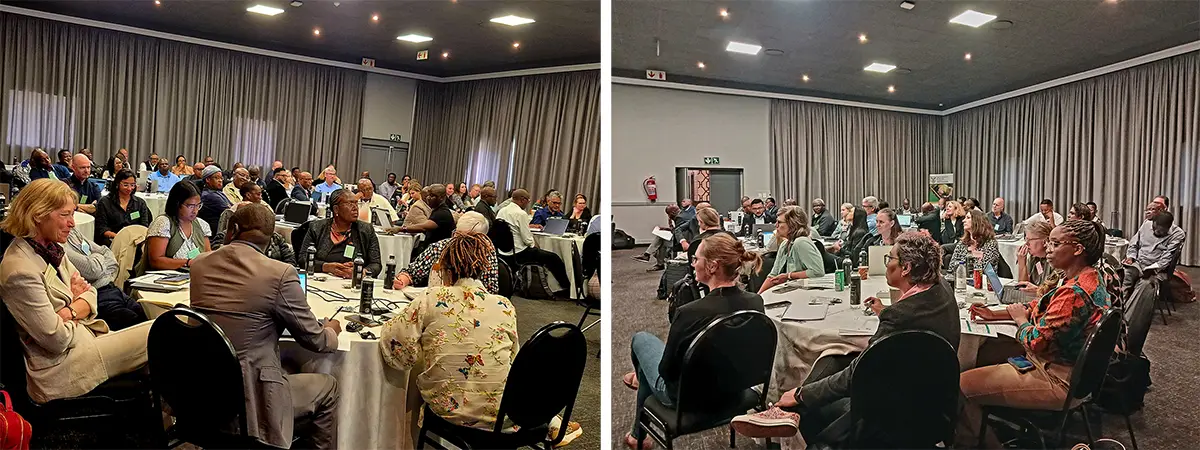
Senior academics, research leaders and postgraduate specialists interrogated the structural, institutional and epistemic pressures shaping postgraduate training across the higher education sector.
Quality of supervision
Professor Setumo Motloung (right), Director of Postgraduate Studies at the Central University of Technology (CUT), reinforced this concern, arguing that accountability within supervision remains uneven.
“No supervisor will admit they are the problem,” Professor Motloung remarked, pointing to a tendency within institutions to attribute delays and failures solely to students.
He further warned that excessive supervisory loads undermine quality, noting that even well-trained supervisors cannot provide adequate attention when overwhelmed.
Offering a constructive pathway, Professor Loyiso Jita, Dean at the University of the Free State (UFS), advocated for co-supervision as a mechanism to build capacity and improve quality over time.
“You can build capacity through collaboration,” Professor Jita suggested, encouraging academics to work in complementary teams rather than in isolation.

Collaboration is a winning formula
The discussion also revealed institutional asymmetries between public and private higher education providers. Dr Helena van Mook, Dean of Postgraduate Studies at IMM Graduate School, observed that while public universities benefit from state-supported capacity-building initiatives, private institutions often rely on partnerships with public-sector academics.
“We are working with public university supervisors,” Dr van Mook explained, underscoring the need for sustainable collaborative models across the sector.

Funding challenges
Funding constraints, however, cut across institutional divides. Professor Sheldon Marshall (left), Deputy Vice-Chancellor for Research, Technology, Innovation and Partnerships at Cape Peninsula University of Technology (CPUT), argued that existing funding frameworks remain insufficiently responsive to the full postgraduate pipeline.
“We need funding models that support the entire value chain,” Professor Marshall emphasised, pointing to industry-linked research chairs that integrate undergraduate, master’s and doctoral training while aligning research with real-world challenges.
Participants further raised concerns about the marginalisation of part-time students, who often fall outside formal funding structures despite facing significant financial pressures.
Dr Jennifer Fitchett, Head of Postgraduate and Researcher Development at the University of the Witwatersrand (Wits), explained that funding regimes shape institutional behaviour in profound ways. “What guides your programme is often the funding you receive,” she observed, noting the divergent incentives between public and private systems.
Beyond the academy, questions of employability surfaced as a pressing concern. Professor Thembinkosi Mabila, Director of Research at the University of Limpopo (UL), warned of a growing disconnect between doctoral output and labour market absorption.
“You find PhD graduates not employed in the fields for which they are qualified,” Professor Mabila said, pointing to an expanding pool of postdoctoral researchers competing for limited opportunities.
At the same time, participants criticised delays in funding disbursements from the National Research Foundation (NRF), arguing that late payments disrupt academic progress and place undue strain on students.
In contrast, Professor Anil Chuturgoon, Deputy Vice-Chancellor for Research and Innovation at the University of KwaZulu-Natal (UKZN), highlighted an institutional intervention designed to incentivise timely completion.
At UKZN, he explained, master’s students who complete within one year and doctoral candidates who finish within three years qualify for full fee remission.
“There are no fees at all,” Professor Chuturgoon said, presenting the model as an example of how targeted incentives can improve throughput.
Across these engagements, a deeper structural issue emerged: the misalignment between policy frameworks and the realities of postgraduate education. Participants argued that current systems often incentivise throughput over quality, while creating barriers to collaboration, interdisciplinarity and innovation.

Counterproductive incentives
Associate Professor Japie Greeff, who is the Research Coordinator at Belgium Campus iTversity, warned that the sector’s challenges are rooted in deeper systemic contradictions. “A recurring issue is the misalignment of policy,” Greeff argued. “Incentives shape behaviour that becomes entrenched and ultimately undermines the system. When policy creates structural barriers to implementation, it disincentivises quality and requires intervention at a senior, system-wide level.”
Calls were made for renewed engagement with national stakeholders, including the Department of Science, Technology and Innovation (DSTI) and the Council on Higher Education (CHE), to recalibrate policy in line with sector needs.
As the colloquium progressed, Dr Mzilakazi’s opening reflection returned as a unifying thread. The issues that “keep leaders awake at night” were not isolated institutional concerns, but indicators of systemic strain.
The EQPE colloquium concluded with a clear and collective understanding: strengthening postgraduate education requires coordinated action across universities, government and industry, anchored in quality, accountability and public purpose
Bhekisisa Mncube is a contract writer for Universities South Africa.